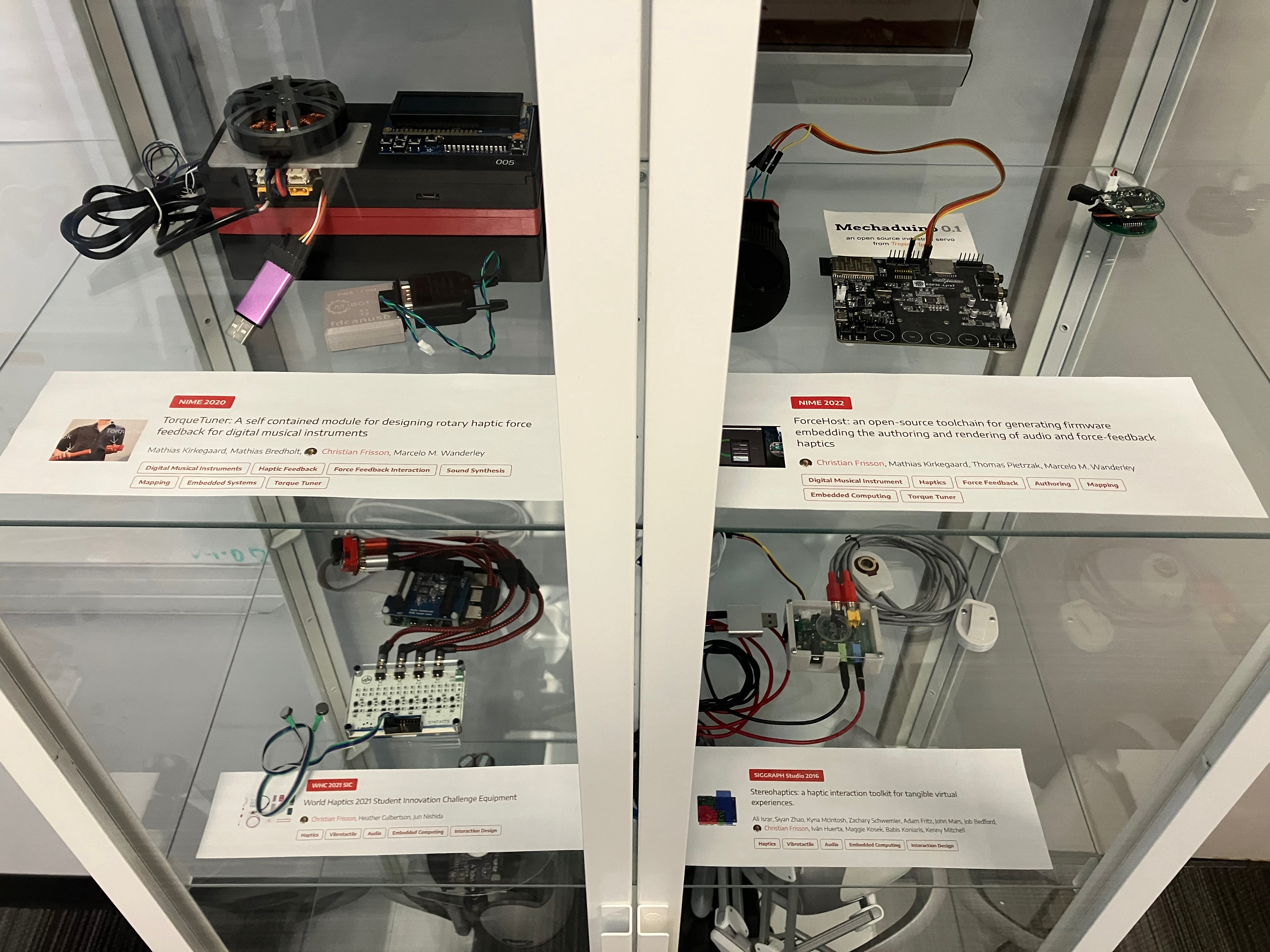
Figure: A display case with haptic musical artifacts: force-feedback on top shelf (TorqueTuner and ForceHost), vibrotactile on lower shelf (Syntacts and StereoHaptics).
Motivation
Describe the rationale for the workshop, issues that will be addressed, and clear objectives with reference to NIME topics, themes, and previous publications.
Haptics has been a NIME topic right from the start: word stem “haptic” was mentioned in NIME’01 workshop papers, including (Orio et al. 2001; Verplank et al. 2001) and then part of a publication title for the first time at NIME’02, the first NIME conference (Verplank et al. 2002), while NIME keynote presenters focused or discussed HMA on several occasions (e.g. 2003 (Cadoz et al. 2003), 2013, 2015 (Sheffield et al. 2015) & 2019). There are 49 occurrences of the word “haptic” in titles and 84 in abstracts for NIME paper proceedings up to 2025, as searchable in the github repository versioning the NIME bibliography.
Though common in NIME, Haptic Musical Artifacts (HMA) can only be experienced in person. With the exception of a few sub-categories of haptic hardware that are widely deployed, for instance, vibrotactile haptics in mobile phones, most HMA remain confined to research labs. Force-Feedback devices, on the other hand, are much less available to the NIME community. They tend to be expensive and demand hardware and software specifications which are not straightforward to implement. Furthermore, these devices become rapidly obsolete as computer hardware and software evolve, making them even less accessible. Finally, the replicability of such devices is not evident due to proprietary protocols (firmware, drivers, etc.) and the unavailability of original electronic circuits. All these issues have a decisive negative impact on the sustainability of haptic research in NIME and elsewhere, with most projects having a lifespan of a few years (typically the duration of a PhD thesis).
This workshop aims to present a retrospective review of HMA, specifically, force-feedback devices used in musical applications, accompanied by hands-on demonstrations, to provide NIME attendees with an opportunity to revisit and experience research on haptics and music. Furthermore, a general discussion will be held on ways to create a consortium of researchers interested in the replicability and sustainability of HMA within the NIME community.
Workshop Structure
Describe the planned activities or events taking place in the workshop.
We plan to host a short workshop (up to three hours) structured into 3 activities: an overview of HMA in NIME and other venues (Sec. 2.1), a hands-on series of demos of HMA (Sec. 2.2), and a discussion leading to the creation of a consortium of NIME researchers interested in the availability, replicability and sustainability of HMA (Sec. 2.3).
Overview of HMA (30 min)
In a short lecture format, the organizers will review the most representative works on force-feedback devices in musical applications, addressing questions such as: How can we experience haptic and music artifacts when devices or displays are not available nearby? How can we replicate previous artifacts when computing standards are obsolete (for example, parallel ports or FireWire connectors)? (Frisson and Wanderley 2023) Why recreate devices from scratch when most components (actuators, sensors, and mechanical assembly) of existing devices are still functional? We also plan to address issues of accessibility (as defined for people with specific interaction needs) and diversity (as more commonly expanded to equity, diversity, and inclusion) in HMA research.
Retrospective of HMA works and hands-on demos (1 hour 30 minutes)
This session will comprise 5-minute talks and hands-on demos by attendees.
A call for demo submissions will be issued that focuses on the challenges and opportunities of previous HMA work (rather than bleeding-edge or work-in-progress demos). Attendees will submit an abstract-type paper (1 page) using the NIME template. Organizers will accept 4 to 5 submissions. Accepted submissions will be archived in the Zenodo repository alongside other NIME contributions. Each abstract should describe and critique at least one contribution (300 words) and walk readers through the proposed workshop demo (200 words). Initial contributions include, but are not limited to, previously published work, at NIME or other HMA-related venues such as HAID, World Haptics and Haptics Symposium, CHI, UIST, AudioMostly, etc. We welcome replications of their own or third-party artifacts, in a manner similar to how the NIME Reader featured third-party critiques (Jensenius and Lyons 2016). Examples of HMA equipment provided by the organizers are given in Sec. 4.1.
Discussion (1 hour)
We will open a discussion forum to further refine HMA challenges and opportunities arising from feedback from the overview and the experiential demo retrospective. Desired outcomes include co-authoring a joint publication with attendees and organizing future HMA events, such as a multi-day seminar, to collectively refine the HMA research agenda.
Demos will be available until the end of the workshop to support the discussion in this last session.
Organisers
Include Workshop organiser(s) with short bio(s) up to 200 words including background relating to proposed topic, and affiliation and contact information. Include additional speakers name(s), affiliation(s), and contact information.
Chairs
Workshop chairs Christian Frisson and Marcelo Wanderley have been collaborators for 20 years, beginning in 2006. They have separately organized HMA-related events, including: FF&M’17, HAID’19 and HAID’20.
-
Christian Frisson is an assistant professor at the University of Calgary with the Interactions Lab, leading the SHIVERS Group (2025-present). Christian has industry experience as Senior R&D Engineer at Ansys (part of Synopsys) (2023-2025), and as Researcher / Developer at the Society for Arts and Technology (SAT) (2021-2023). Christian was postdoctoral researcher: 1) at McGill University with the Input Devices and Music Interaction Lab (IDMIL) funded by his Mitacs Elevate fellowship with Haply, including a collaboration with the National Research Council Canada (NRC) (2019-2020), 2) at the University of Calgary with the Interactions Lab collaborating with the Canada Energy Regulator (CER) and VizworX (2017-2018) and 3) at Inria in France with the Mjolnir team collaborating on a European Horizon 2020 project including with the French Alternative Energies and Atomic Energy Commission (CEA) (2016-2017). Christian obtained his PhD at the University of Mons, numediart Institute, in Belgium (2015); and his Master in Science in “Art, Science, Technology” from Institut National Polytechnique de Grenoble with the Association for the Creation and Research on Expression Tools (ACROE) (Wanderley and Frisson 2023), in France (2006), and his Master in Engineering in Acoustics and Metrology from Ecole d’Ingénieurs - Le Mans Université (ENSIM), in France (2005).
-
Marcelo M. Wanderley holds a Ph.D. degree from the Université Pierre et Marie Curie (Paris VI), France, on acoustics, signal processing, and computer science applied to music. His interdisciplinary research focuses on the development of novel interfaces for music performance. He has authored and co-authored several dozen scientific and technological publications on NIME, including the development of open databases on academic resources and sensor and actuator technologies for musical applications: the Interactive Systems and Instrument Design in Music Working Group (ISIDM) and the SensorWiki.org projects. In 2000, he co-edited the first English-language research reference entirely devoted to this area, Trends in Gestural Control of Music (Wanderley & Battier, 2000). In 2003, he chaired the second International Conference on New Interfaces for Music Expression (NIME03), and in 2006, he co-wrote the first textbook on this subject, New Digital Musical Instruments: Control and Interaction Beyond the Keyboard (Miranda & Wanderley, 2006). In September 2016, he was appointed a member of Computer Music Journal’s Editorial Advisory Board. He is a senior member of the ACM and of the IEEE.
Presenters
We will issue a call for participation and select 4-5 participants to discuss their work and showcase HMA demos, as described in section 2.2.
We bring a subset of the showcase of use-cases of replication demos, including TorqueTuner that we co-created (Kirkegaard et al. 2020; Niyonsenga et al. 2022).
Description of technical and space requirements
Including equipment required or brought by organisers; information on whether in-person or hybrid attendance is supported; expected size of event; and specific venue features.
Equipment
A small classroom-like setup with a projector or large screen and one set of stereo loudspeakers, active or amplified, which we will rotate to present HMA demos.
Requirements
We expect participants to bring their own HMA equipment and a computing device to present supplementary materials during the retrospective.
We would appreciate access to a printer to create name tags and demo abstract printouts for provenance. We may use self-serve printers as a workaround, or ask participants to sketch on office supplies (e.g., pen and paper) that we would bring.
Ethics statement
Please note that an Ethical Standards section is required for all NIME submissions. This could include information regarding sources of funding, sustainability factors, potential conflicts of interest, informed consent if the research involved human participants, statement on welfare of animals if the research involved animals, or other ethical factors that are relevant to the work.
We will ensure that the workshop is as diverse as possible. HMA has potential applications in accessibility, an area of expertise that we want to bring to the workshop. The call for submissions will emphasize the participation of graduate students and junior researchers. To our knowledge, there are no conflicts of interest.
Media links (optional)
Links to supporting audio, visual, and/or online documentation, e.g. a workshop web page.
Please browse our open-source workshop website hosted on GitHub Pages to version materials collaboratively produced before (overview presentation materials and demo abstracts), during (collaborative discussion materials), and after the workshop (publications and consortium): https://NIME2026HMA.github.io
References
Cadoz, Claude, Annie Luciani, Jean-Loup Florens, and Nicolas Castagné. 2003. “ACROE — ICA Artistic Creation and Computer Interactive Multisensory Simulation Force Feedback Gesture Transducers.” Proceedings of the International Conference on New Interfaces for Musical Expression, 235–46. https://doi.org/10.5281/zenodo.1176494.
Frisson, Christian, and Marcelo M. Wanderley. 2023. “Challenges and Opportunities of Force Feedback in Music.” Arts 12 (4): 147. https://doi.org/10.3390/arts12040147.
Jensenius, Alexander Refsum, and Michael J. Lyons. 2016. “Trends at NIME—Reflections on Editing A NIME Reader.” Proceedings of the International Conference on New Interfaces for Musical Expression, 439–43. https://doi.org/10.5281/zenodo.1176044.
Kirkegaard, Mathias, Mathias Bredholt, Christian Frisson, and Marcelo Wanderley. 2020. “TorqueTuner: A Self Contained Module for Designing Rotary Haptic Force Feedback for Digital Musical Instruments.” Proceedings of the International Conference on New Interfaces for Musical Expression (Birmingham, UK), July, 273–78. https://doi.org/10.5281/zenodo.4813359.
Niyonsenga, Albert-Ngabo, Christian Frisson, and Marcelo M. Wanderley. 2022. “TorqueTuner: A Case Study for Sustainable Haptic Development.” 11th Intl. Workshop on Haptic and Audio Interaction Design, HAID’22.
Orio, Nicola, Norbert Schnell, and Marcelo M. Wanderley. 2001. “Input Devices for Musical Expression : Borrowing Tools from HCI.” Proceedings of the International Conference on New Interfaces for Musical Expression, 15–18. https://doi.org/10.5281/zenodo.1176370.
Sheffield, Eric, Sile O’Modhrain, Michael Gould, and Brent Gillespie. 2015. “The Pneumatic Practice Pad.” In Proceedings of the International Conference on New Interfaces for Musical Expression, edited by Edgar Berdahl and Jesse Allison. Louisiana State University. https://doi.org/10.5281/zenodo.1179178.
Verplank, Bill, Michael Gurevich, and Max Mathews. 2002. “THE PLANK: Designing a Simple Haptic Controller.” Proceedings of the International Conference on New Interfaces for Musical Expression, 177–80. https://doi.org/10.5281/zenodo.1176466.
Verplank, Bill, Craig Sapp, and Max Mathews. 2001. “A Course on Controllers.” Proceedings of the International Conference on New Interfaces for Musical Expression, 7–10. https://doi.org/10.5281/zenodo.1176380.
Wanderley, Marcelo M., and Christian Frisson. 2023. “Force-Feedback and Music: Five Decades of Research and Development at ACROE: An Interview with Claude Cadoz (ACROE, Grenoble, France).” Arts 12 (4): 159. https://doi.org/10.3390/arts12040159.
Posts
subscribe via RSS